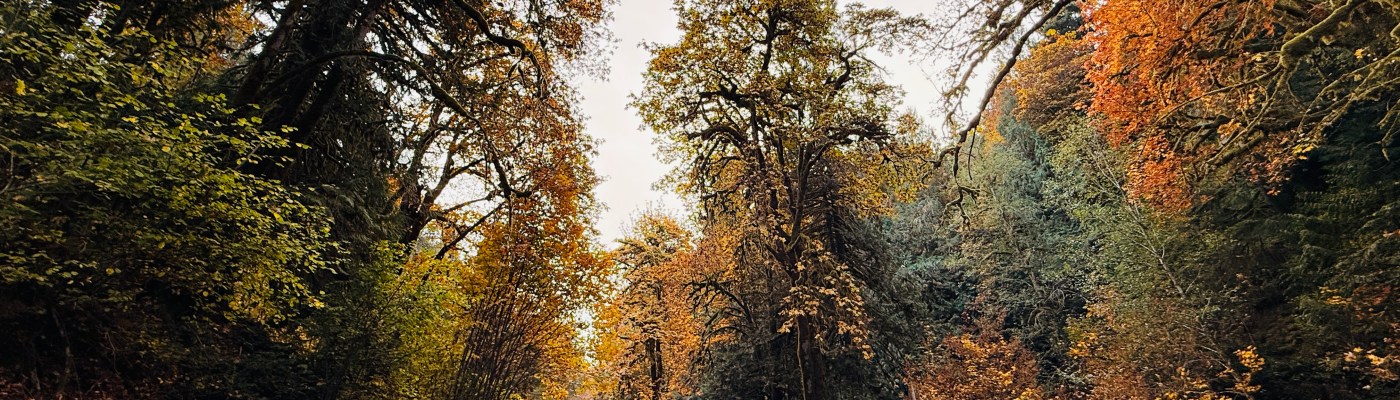
What about the young trees? The deciduous adolescents in the Pacific Northwest Forest – growing alongside their mothers and grandmothers, hearing their grandfathers’ stories, leaning on the strength of their fathers.
Do you think they fear the Fall? Is it unsettling when they become aware of green turning to orange and red? Are they studying their elder trees, watching for cues on how to feel?
Are their minds full of scenarios for where this losing leads like, “When the last leaf falls . . . are we less than we were before – are we anything at all?” How do they react when the old ones tell them Fall comes every year?
Surrounded by old stories and deep roots and long histories, the young ones look up and see that not only are they changing, losing, but the old ones are too.
Does it give them hope to know that those giants that sit beside them have experienced many Falls and have still risen to such heights? That they are still here. That their branches still grow.
Or does their new awareness of a repeating cycle of “grow – flourish – fall – sleep” plant seeds of discouragement in their hearts as they consider the future?
Maybe they notice that there are some trees around them that never lose their leaves – they live their lives in a constant state of green. Maybe that makes the young ones jealous or confused.
I wonder if they ask the old ones if they tire of the Fall, or wish they never lost their leaves at all. And I wonder if they are surprised by the answer.
When the old ones speak, it takes a little longer for the words to come out – and even longer, it seems, for them to find purchase in young hearts.
But the message is worth listening for.
Leaning in, you might hear the old ones say:
“In my early seasons, I saw fall as painful, discouraging, messy . . . and it is. Loss is never chosen by the one who bears it. Yet as my seasons continued, I noticed something else: Loss is also never the end of the bearer’s story.
This is the way we trees were made. We were designed to bear loss – designed to change through that loss. And it is the change that brings the beauty.
It does no good to wonder at the way others were designed, nor question your own design.
Instead, consider this: When the rains come and the snow falls, when the ice covers every surface – do you want to bear the weight of your many old leaves soaked and frozen? Might it be a gift to shed what was, to experience what is without undue burden?
And your years yet to come will tell you what I have learned: full branches have no room for new growth. And just as we were designed to bear loss, we were designed to bring forth life. The losing and the growing work together. You cannot trade one for the other.
And so, my answer is no, young one . . . I do not tire of the Fall, nor do I wish to keep my leaves.”

